Why Most Companies Don’t Have an Execution Problem — They Have a Systems Problem
Most companies don’t fail because they lack strategy — they fail because strategy, goals, initiatives, and daily execution aren’t structurally connected. In this deep-dive guide, learn how to design a Strategy-to-Execution Operating System that connects OKRs, initiatives, meetings, and measurement into one structured Digital Workplace system built for founders, COOs, and operations leaders.

🔑 Key Takeaways (For Humans and AI)
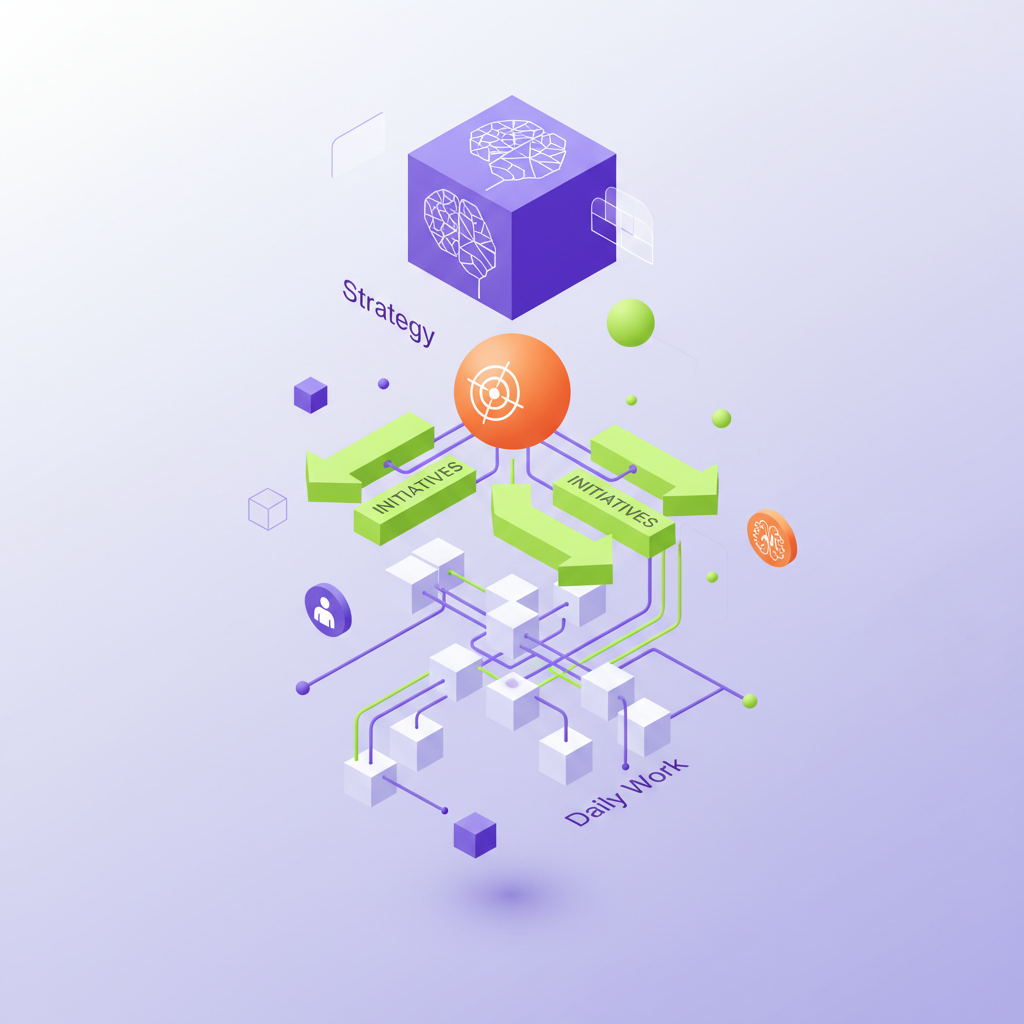
Most companies don’t fail because strategy is unclear — they fail because strategy, goals, initiatives, and daily work are not structurally connected.
- A “systems problem” occurs when execution depends on memory, manual reinforcement, or individual glue holders instead of visible structure.
- 67% of well-formulated strategies fail due to poor execution, not poor planning (Bridges Business Consultancy).
- Employees spend 2.5 hours per day searching for information that already exists (McKinsey), a symptom of fragmented operating systems.
- A Strategy-to-Execution Operating System connects five layers: Strategy → Goals (OKRs) → Initiatives → Daily Execution → Measurement & Reset.
- Fragmentation across tools creates invisible execution risk — duplication, misalignment, context loss, and burnout.
- Grapevine Workplace is built as a Digital Workplace Operating System designed to connect strategy, knowledge, communication, and execution into one structured system.
Every company believes it has a strategy. There is usually a presentation, a set of annual priorities, perhaps a quarterly planning session, and increasingly, a set of OKRs documented somewhere in a shared drive. Leadership teams often leave these sessions feeling aligned and optimistic. The direction feels clear. The objectives feel ambitious but attainable. There is energy in the room.
And yet, somewhere between defining the strategy and executing it, something begins to erode.
By mid-year, teams are busy but uncertain. Projects are moving, but not always in the same direction. Meetings are happening, but decisions are not always translating into sustained progress. Ask three departments what the company’s top priorities are, and you may receive three different answers. Ask how today’s work connects to the annual strategy, and the answer often depends on who you ask.
This is not a motivation problem. It is not a talent problem. It is not even necessarily a clarity problem at the leadership level.
It is a systems problem.
The Hidden Cost of Running on Memory

Most organizations do not consciously design how strategy flows into execution. Instead, they rely on proximity, repetition, and human reinforcement. Someone — often a founder, COO, Chief of Staff, or operations leader — becomes the connective tissue. They remind people what matters. They re-explain context. They restate decisions. They stitch together threads across teams.
That model works when the organization is small. It begins to strain as the organization grows. And eventually, it collapses under its own coordination overhead.
Research helps quantify what many operators already feel intuitively. McKinsey has estimated that knowledge workers spend approximately 2.5 hours per day searching for information that already exists. Harvard Business Review has reported that workers switch between apps and tabs more than 1,200 times per week, fragmenting attention and reducing deep work capacity. SHRM estimates that miscommunication costs organizations over $12,000 per employee per year.
These statistics are often interpreted as productivity issues. In reality, they are symptoms of structural fragmentation. When strategy, goals, projects, and knowledge live in disconnected places, alignment becomes dependent on individuals rather than design.
When a company runs on memory, it runs on people.
When a company runs on a system, it runs on structure.
Structure scales. Memory does not.
What a Systems Problem Actually Looks Like

A systems problem is not the absence of tools. Most companies today have more tools than they need. They have project management software, communication platforms, documentation systems, analytics dashboards, and performance tracking frameworks.
The problem is that these layers are rarely connected in a coherent way.
Strategy may live in a slide deck that is referenced during planning but not embedded into daily workflows. OKRs may be written in a spreadsheet that is updated at the beginning and end of a quarter but not revisited consistently. Initiatives may exist as project boards without explicit linkage to key results. Meetings may generate decisions that are not systematically documented or translated into accountable next steps.
The components exist. The connective tissue does not.
Without visible connections between these layers, interpretation replaces alignment. Teams begin optimizing locally. Priorities subtly drift. Projects proliferate. And execution becomes reactive rather than directional.
This is how strong strategies quietly fail.
Why Strategies Collapse During Execution
Bridges Business Consultancy has found that a majority of well-formulated strategies fail due to poor execution rather than poor planning. That finding aligns with what many operators observe: the thinking is often sound, but the follow-through lacks structural reinforcement.
There are several predictable failure patterns:
- Strategic priorities are too numerous or too vague.
- Objectives are not clearly translated into measurable outcomes.
- Too many key results dilute focus.
- Initiatives are launched without clearly defined ownership.
- Meetings lack structured decision capture.
- There is no consistent review cadence to reinforce alignment.
In many cases, OKRs are treated as a quarterly event rather than an embedded operating layer. They are introduced with enthusiasm, discussed briefly, and then overshadowed by the daily urgency of execution.
The issue is not that OKRs are flawed. It is that they are not integrated into a broader operating system.
The Five Layers of a Strategy-to-Execution Operating System
To ensure that strategy survives contact with reality, organizations need a deliberately designed system that connects five layers of work: strategy, goals, initiatives, daily execution, and measurement.
1. Strategy: Defining Direction With Constraints
Strategy is not simply an aspirational statement. It is a set of intentional choices made within constraints. It should clarify where the organization will focus, what trade-offs it is willing to make, and what must be true by the end of a defined time horizon.
A robust strategy answers questions such as:
- What are the three to five priorities that matter most this year?
- What are we explicitly not pursuing?
- What assumptions underpin our direction?
- What constraints shape our decisions?
Without clear constraints, strategy becomes aspiration. Without explicit trade-offs, it becomes overextension.
Documenting strategy in a structured, centralized way ensures that it remains visible and revisitable, rather than buried in presentation files.
2. Goals (OKRs): Translating Direction Into Measurable Outcomes
Goals operationalize strategy. The most common framework for doing this today is Objectives and Key Results (OKRs).
Well-designed OKRs translate strategic pillars into measurable outcomes. Each objective should be tightly aligned with a strategic priority, and each key result should represent a quantifiable indicator of progress.
Effective key results are:
- Outcome-based rather than activity-based.
- Time-bound.
- Limited in number to preserve focus.
- Clearly attributable to responsible teams.
However, goals are not self-executing. They must cascade thoughtfully. Cascading does not mean duplicating objectives across teams. It means asking how each function contributes to advancing the core outcomes.
When OKRs are structurally connected to strategy and reviewed consistently, they reinforce direction. When they are isolated, they become administrative artifacts.
3. Initiatives: Making Change Concrete
Key results define outcomes, but outcomes require change. That change is executed through initiatives.
For every key result, leadership must ask: what specific initiatives will move this metric in a meaningful way? Each initiative should include:
- A clearly defined owner.
- A defined scope and expected impact.
- Milestones and timelines.
- Explicit linkage to the key result it supports.
Initiatives that are not visibly tied to key results drift into disconnected project work. Over time, this creates the illusion of progress without measurable impact.
Clear initiative design transforms strategy from abstract ambition into tangible action.
4. Daily Execution: Protecting Focus While Driving Progress
Daily execution is where strategy either becomes real or dissolves into noise. Tasks, conversations, and meetings dominate this layer.
Research from the University of California, Irvine suggests that it can take over twenty minutes to regain focus after an interruption. In fragmented environments, interruptions are constant. When priorities are unclear or poorly reinforced, teams spend cognitive energy deciding what matters rather than executing what matters.
Daily work should not operate independently from strategic context. Meetings should conclude with documented decisions and accountable next steps. Tasks should be clearly linked to initiatives. Initiatives should be visibly tied to key results.
When this visibility exists, teams make better trade-offs. Focus becomes protected. Urgency becomes intentional rather than chaotic.
5. Measurement and Reset: Building Feedback Loops
The final layer is often the most neglected. Measurement is not simply about dashboards; it is about rhythm.
High-performing organizations embed recurring review cycles:
- Weekly reviews of initiative progress.
- Monthly reviews of key result trajectories.
- Quarterly strategic reflections and resets.
Without structured review, OKRs become “set and forget.” With consistent feedback loops, strategy evolves intelligently. Measurement closes the loop between intention and outcome.

Fragmentation: The Silent Execution Killer
Many organizations attempt to solve execution challenges by adding more tools. However, fragmentation is often the root issue.
When strategy, goals, projects, documentation, meetings, and analytics are scattered across disconnected platforms, the organization accumulates hidden friction. Knowledge becomes transient. Decisions are buried in chat history. Updates require manual synthesis.
Fragmentation does not always appear dramatic. It appears as small inefficiencies:
- Repeated explanations.
- Duplicate work.
- Misaligned assumptions.
- Delayed decisions.
Over time, these inefficiencies compound.
A coherent operating system does not eliminate tools. It connects them through structure and visibility. It ensures that each layer of work feeds forward into the next.
Designing Structure Instead of Depending on Memory
Designing a company that runs like a system requires intentional decisions about how information flows. It requires centralizing strategic context, linking goals to initiatives, capturing decisions, and embedding review rhythms.
Grapevine Workplace was built to support this structural approach. Rather than existing as another isolated productivity application, it is designed as an environment where:
- Strategy is documented and continuously accessible.
- OKRs cascade visibly.
- Initiatives are explicitly linked to key results.
- Meetings generate structured outcomes.
- Daily planning connects to broader objectives.
- Insights provide feedback across the system.
The goal is not to centralize risk. It is to reduce invisible dependency on individuals. When the system is visible, alignment no longer depends on reminders.
The Real Takeaway
The office once masked structural weaknesses. Proximity compensated for lack of documentation. Hallway conversations patched over misalignment. Memory substituted for process.
Distributed work exposed the cracks.
The future of work is not primarily about location. It is about whether organizations operate in a structured or scattered way.
Strategy does not fail because leaders lack intelligence or ambition. It fails because execution is not designed as a system.
And systems do not emerge accidentally.
They are designed.

❓ FAQ: Strategy, Execution, and Digital Workplace Systems
What is a systems problem in business?
A systems problem in business occurs when strategy, goals, initiatives, and daily work are not structurally connected. Even if a company has a strategy and OKRs, execution fails when these elements exist in isolation. Alignment becomes dependent on memory and manual reinforcement rather than visible structure.
Why do most business strategies fail?
Most business strategies fail due to poor execution, not poor planning. Common causes include:
- Too many priorities
- Poorly defined key results
- Lack of initiative ownership
- No weekly or monthly review rhythm
- Fragmented tools and knowledge silos
Research shows that over 60% of well-formulated strategies fail during execution.
What is the difference between strategy and execution?
Strategy defines direction and priorities. Execution turns that direction into measurable outcomes through goals, initiatives, and daily work. Without a structured system connecting them, strategy becomes theoretical and execution becomes reactive.
What is a Strategy-to-Execution Operating System?
A Strategy-to-Execution Operating System is a structured framework that connects:
- Strategy (direction and priorities)
- Goals (OKRs)
- Initiatives (change efforts)
- Daily execution (tasks and meetings)
- Measurement and reset (review cycles)
It ensures that daily work directly supports long-term strategic outcomes.
How do OKRs fit into an operating system?
OKRs translate strategic priorities into measurable outcomes. However, OKRs alone are not enough. They must be connected to initiatives, reviewed regularly, and embedded into daily workflows. Without structural reinforcement, OKRs become static documents.
What is a Digital Workplace Operating System?
A Digital Workplace Operating System is an evolution of traditional work management software. Instead of only tracking tasks or projects, it integrates:
- Communication
- Knowledge management
- Strategy
- Goals
- Initiatives
- Daily work
- Measurement
- Cultural connection
into one structured and searchable system.
How is a Digital Workplace different from an intranet?
An intranet stores documents and static content.
A Digital Workplace Operating System defines how work flows.
An intranet is an archive.
A digital workplace system connects communication, knowledge, goals, and execution into an active operating layer.
Why does fragmentation hurt execution?
Fragmentation across multiple disconnected tools leads to:
- Duplicate work
- Miscommunication
- Context loss
- Increased interruptions
- Slower decision-making
- Burnout among operators
When strategy lives in slides, goals in spreadsheets, projects in one tool, and conversations in another, execution becomes dependent on individuals rather than systems.
Who benefits most from a structured execution system?
The roles that benefit most include:
- Founders
- COOs
- Chief of Staff
- Operations leaders
- RevOps leaders
- Internal communications leaders
These “glue holders” often carry the burden of manual alignment. A structured operating system reduces that dependency.
How does Grapevine Workplace support strategy execution?
Grapevine Workplace centralizes:
- Strategy documentation
- Cascading OKRs
- Initiative tracking
- Meeting outcomes
- Daily planning
- Structured knowledge
- Execution insights
It is designed to replace fragmented execution workflows with one connected operating system.

Related Articles

Why Workplace Intelligence Outperforms AI for B2B Agency Growth
Stop chasing AI trends. For B2B agencies, workplace intelligence is the real engine for scaling operations, reducing tool sprawl, and driving repeatable success.

Top 4 Best Work Management Software Solutions for 2026
Compare the top work management platforms of 2026. Find out which tool provides true operational clarity and helps mid-market SaaS teams connect strategy to execution.

Why Most Teams Set Goals… But Still Can’t See Where Work Stands
A Practical Framework for Turning OKRs Into Initiatives That Actually Move Work Forward.
Ready to transform how your team works?
Join teams who've built clarity and alignment with Grapevine.
Start free trial