How to Set OKRs That Actually Work
A Practical Framework to Turn Strategy Into Measurable Progress and Real Alignment by using Objectives and Key Results (OKRs) the right way.

Key Takeaways OKRs are not goals or task lists — they are a measurement system for progress
- Effective OKRs are derived from strategy and operating plans, not created in isolation
- Company-level OKRs should act as the top of the pyramid, cascading across leadership, teams, and individuals
- Key Results must measure outcomes, not activities
- A structured rollout process ensures alignment across the organization
- Weekly check-ins and monthly scoring are required to keep OKRs alive
- Quarterly reflection turns OKRs into a compounding system, not a one-time exercise
Why Most OKRs Fail
Most companies don’t fail because they lack ambition.
They fail because they lack clarity around progress.
In many organizations, OKRs are introduced with good intent — to create alignment, accountability, and focus. But in practice, they often degrade into:
- Task lists disguised as goals
- Metrics disconnected from strategy
- Quarterly exercises that disappear after planning
- Documents that are created, shared, and then ignored
Research reinforces this pattern:
- According to Gallup, only a small percentage of employees strongly agree they understand what is expected of them at work
- McKinsey has found that unclear priorities and misalignment are among the top drivers of organizational inefficiency
- Harvard Business Review highlights that teams frequently measure activity rather than outcomes, leading to “busy work” without meaningful progress
These are not execution problems.
They are measurement problems.
When organizations fail to define what progress actually looks like, they default to tracking effort. And effort, without direction, creates motion without advancement.
OKRs fail when they are treated as a planning exercise instead of a system for measuring progress against strategy.

What OKRs Actually Are
OKRs (Objectives and Key Results) are often misunderstood.
They are not:
- A project plan
- A task list
- A collection of initiatives
- A replacement for strategy
OKRs are a measurement layer.
They answer one critical question:
Are we making real progress on what matters most?
This distinction is important.
If your OKRs describe what your team is doing, they are not OKRs.
They are activity trackers.
Effective OKRs describe what becomes true as a result of execution. They define outcomes that signal whether the company is moving forward.
In a functioning system:
- Strategy defines direction
- The operating plan defines how the company behaves
- OKRs define how progress is measured
Without this structure, OKRs become disconnected from reality.

The Bridge Between Strategy and OKRs
OKRs should never be created from scratch.
They are derived.
This is where most teams go wrong.
Instead of asking:
“What should our OKRs be this quarter?”
The correct question is:
What would meaningful progress look like this quarter based on our operating plan?
This creates a clear relationship:
- Strategy defines the constraint (what matters and why)
- Operating Plan distributes that constraint across the year
- OKRs measure whether progress is being made
OKRs do not change direction.
They make direction measurable.
This is what transforms strategy from an abstract concept into a system that can be tracked, evaluated, and improved.
The OKR Pyramid: How Alignment Actually Happens
One of the most important structural elements of OKRs is how they are created across the organization.
OKRs should not be developed independently at every level.
They should cascade.
The OKR Pyramid Structure
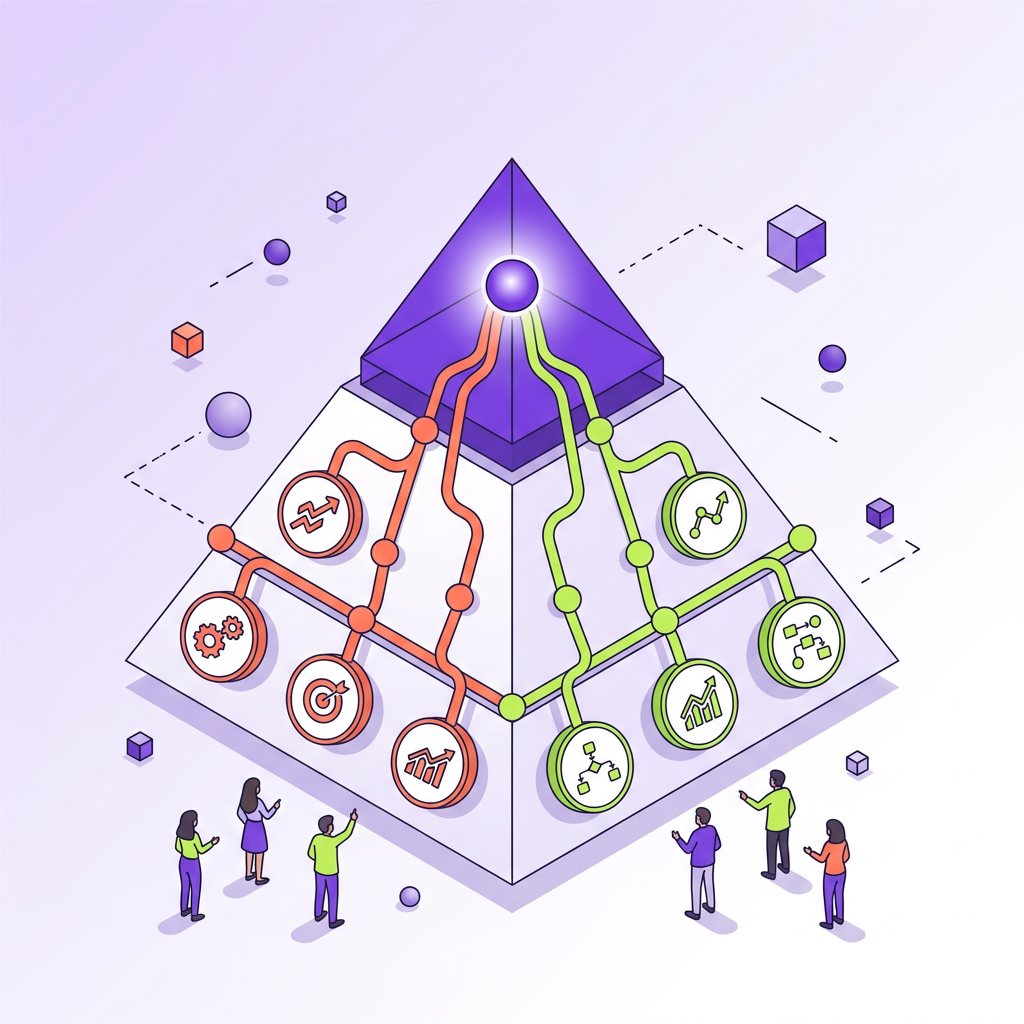 Company-Level OKRs (Top of Pyramid)
- Define the primary objective and key results for the organization
Leadership-Level OKRs
- Translate company OKRs into functional priorities (Sales, Product, Ops, etc.)
Team-Level OKRs
- Align team outcomes to support leadership objectives
Individual OKRs (Optional)
- Connect individual work to team and company priorities
This structure ensures that:
- Everyone is working toward the same outcomes
- Efforts are coordinated, not duplicated
- Progress is measurable at every level
- Alignment is structural, not dependent on communication
Without this pyramid, teams create OKRs in isolation — which leads to fragmentation and misalignment.
OKRs Explained: How to Set Objectives & Key Results That Drive Real Progress
How to Build OKRs (Step-by-Step Framework)
Step 1 — Start with the Company Objective
 The company defines the top-level objective first.
This should come directly from the operating plan.
It represents what the organization is trying to accomplish during the quarter.
Example:
Validate that the company can replace manual coordination for cross-functional initiatives.
This objective should be:
- Clear
- Focused
- Tied to the annual direction
Step 2 — Define Key Results (Outcomes, Not Tasks)
Key Results measure progress toward the objective.
They must be:
- Specific
- Measurable
- Outcome-driven
Examples:
- Acquire 5 design partners running real initiatives
- Run 3 cross-functional initiatives within the system
- Confirm reduced manual coordination from 3 operators
- Secure 2 reference-ready customers
Notice the distinction:
These are not actions.
They are conditions that become true.
Step 3 — Validate with the Outcome Test
A simple test ensures your Key Results are correct:
If these Key Results are achieved, would the business have moved forward — even if we didn’t know how it happened?
If the answer is no, the Key Result is likely describing activity rather than progress.
Step 4 — Cascade Across the Organization
Once company OKRs are defined:
- Leadership translates them into functional OKRs
- Teams align their OKRs to support those outcomes
- Individuals connect their work to those priorities
Each level should maintain a clear line of sight to the company objective.
This creates alignment without requiring constant coordination.

The OKR Build Timeline (Cadence for Alignment)
Timing matters.
If OKRs are built simultaneously across the company, misalignment is almost guaranteed.
A structured rollout ensures clarity and consistency.
Recommended OKR Creation Timeline
Week 1
Company-level OKRs finalized
Week 2
Leadership drafts OKRs → review and approve
Week 3
Teams draft OKRs → review and approve
Week 4
Individual OKRs finalized
This sequence ensures that each layer builds on the one above it.
It transforms OKRs from a chaotic exercise into a coordinated system.
The Missing Layer: How OKRs Stay Alive
This is where most organizations fail.
They create OKRs…
and then stop interacting with them.
For OKRs to work, they must become part of how the company operates.
Weekly Cadence
- Team-level check-ins
- Progress updates
- Identification of blockers
Monthly Cadence
- Score each Key Result
- Evaluate progress
- Adjust execution (not direction)
- Re-align teams as needed
Integration into Meetings
OKRs should be visible in:
- Team meetings
- Leadership reviews
- One-on-ones
What leaders consistently focus on signals priority.
If OKRs are not discussed regularly, they lose importance.
End-of-Quarter Reflection and Scoring
At the end of the quarter, OKRs transition from measurement to learning.
This phase is critical.
Final Scoring
Each Key Result is evaluated:
- What was achieved?
- What fell short?
- What changed during execution?
Company All-Hands Reflection
The results should be shared and discussed across the organization:
- What progress was made
- What worked
- What didn’t
- Where improvement is needed
Preparing for the Next Quarter
The insights from this process inform:
- The next set of company OKRs
- Adjustments to execution strategy
- Improvements to measurement
This creates a feedback loop.
Each quarter becomes more informed than the last.

The Five Biggest OKR Mistakes
- Writing Key Results as tasks
- Creating OKRs without a strategy or operating plan
- Setting too many priorities
- Failing to review and score regularly
- Treating OKRs as a quarterly exercise instead of a continuous system
These mistakes lead to misalignment, wasted effort, and lack of progress.
What Healthy OKRs Feel Like
When implemented correctly, OKRs feel:
- Clear
- Focused
- Measurable
- Grounded in reality
- Reinforced through cadence
When implemented poorly, they feel:
- Vague
- Overloaded
- Ignored
- Disconnected from actual work
The difference is not in the framework.
It is in the system around it.
Frequently Asked Questions
What are OKRs in business?
OKRs (Objectives and Key Results) are a framework used to define and measure progress toward specific outcomes aligned with company strategy.
How are OKRs different from KPIs?
OKRs define directional progress toward strategic objectives, while KPIs track ongoing performance metrics.
How many OKRs should a company have?
Most companies should focus on 1–3 objectives with 3–5 key results each per quarter to maintain clarity and focus.
Why do OKRs fail?
OKRs fail when they are disconnected from strategy, written as tasks, not reviewed consistently, or not embedded into company cadence.
How often should OKRs be reviewed?
OKRs should be reviewed weekly (progress), monthly (scoring), and quarterly (final evaluation and reset).
Final Takeaway
OKRs are not about setting goals.
They are about defining what progress actually looks like.
When done correctly, they:
- Translate strategy into measurable outcomes
- Create alignment across the organization
- Provide clarity on what matters
- Enable consistent evaluation and improvement
But they only work when they are part of a system.
Strategy defines direction.
The operating plan distributes focus.
OKRs measure progress.
Execution drives outcomes.
Together, they form a system where:
- work is aligned
- progress is visible
- and improvement compounds over time
That is how companies move from activity…to actual progress.

Related Articles

Why Workplace Intelligence Outperforms AI for B2B Agency Growth
Stop chasing AI trends. For B2B agencies, workplace intelligence is the real engine for scaling operations, reducing tool sprawl, and driving repeatable success.

Top 4 Best Work Management Software Solutions for 2026
Compare the top work management platforms of 2026. Find out which tool provides true operational clarity and helps mid-market SaaS teams connect strategy to execution.

Why Most Teams Set Goals… But Still Can’t See Where Work Stands
A Practical Framework for Turning OKRs Into Initiatives That Actually Move Work Forward.
Ready to transform how your team works?
Join teams who've built clarity and alignment with Grapevine.
Start free trial