Grapevine Workplace vs. Teamwork.com: Which Is Better for Agencies?
Teamwork is stronger for resource planning and project profitability. Grapevine connects the broader client, work, communication, people, and AI system.

Teamwork.com is stronger for agencies that need mature time tracking, resource forecasting, utilization management, budgets, and detailed project profitability. Grapevine Workplace is stronger for agencies that want the client lifecycle, project delivery, communication, meetings, knowledge, employee experience, and AI connected in one operating system.
Neither platform is simply another project-management tool. The more useful question is what problem your agency needs the platform to solve.
If your biggest constraint is controlling billable time, capacity, utilization, and project economics, Teamwork is likely the better fit. If your biggest constraint is fragmented information spread across your CRM, project tool, inboxes, meetings, documents, client portals, and employee systems, Grapevine Workplace offers the more differentiated approach.
Grapevine Workplace vs. Teamwork.com at a glance
Choose Teamwork.com when:
- Your agency needs detailed time tracking and billable-hour controls.
- Resource forecasting, workload planning, utilization, and project profitability are central to operations.
- You want a mature professional-services automation platform focused on controlling client work.
- Your agency already has separate systems for CRM, email, meetings, knowledge, contracts, and employee feedback.
Choose Grapevine Workplace when:
- Your agency wants clients, contracts, projects, communication, knowledge, meetings, and employee context connected in one system.
- You want the client journey to flow from CRM and contracts into intake, workspaces, client portals, delivery, updates, files, and payments.
- You want chat, email, calendar, video meetings, knowledge, playbooks, employee profiles, and weekly pulse surveys alongside project work.
- You want AI to work across shared agency context instead of operating inside one isolated module.
What is Teamwork.com?
Teamwork.com is an AI-powered professional-services automation platform built for businesses that deliver client work. Its strongest capabilities are project management, time tracking, workload and capacity planning, budgets, retainers, utilization, reporting, and profitability analysis.
For agencies that sell time, manage many concurrent projects, and need tight visibility into planned versus actual effort, Teamwork offers a mature operational toolkit.
Its client-collaboration capabilities include free client users, project updates, proofs, milestones, and visibility across client projects. TeamworkAI supports project setup, task management, resource planning, smart filters, and other workflows within Teamwork's project and resource-management environment.
What is Grapevine Workplace?
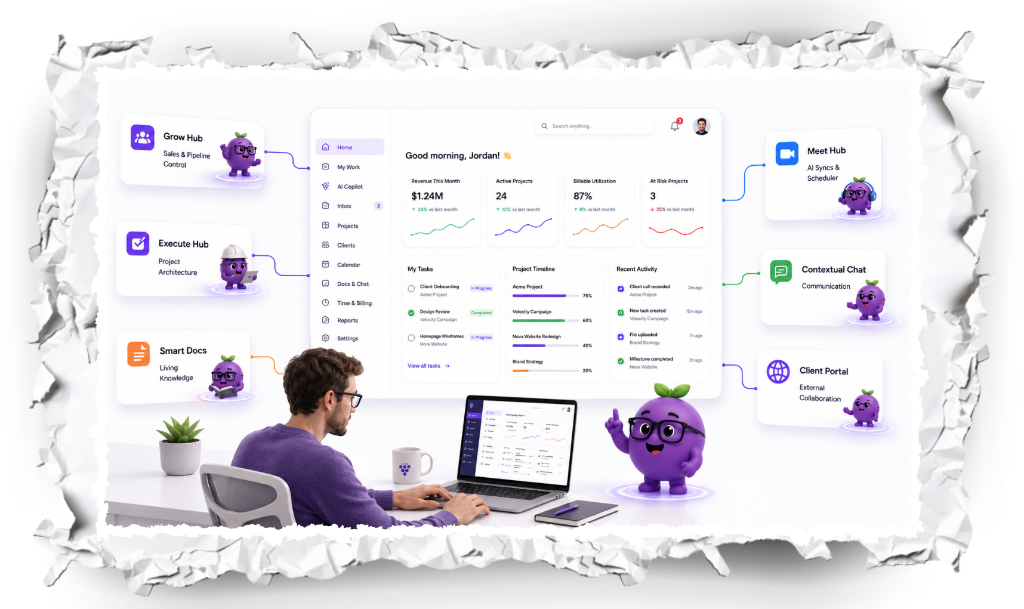
Grapevine Workplace is a connected operating system for agencies. It brings the client lifecycle, work delivery, internal communication, meetings, organizational knowledge, and employee context into one environment.
Grapevine Workplace includes CRM, contracts, workspaces, projects, tasks, client portals, chat, email, calendar, video conferencing, meetings, knowledge, playbooks, docs, forms, files, tables, employee profiles, and weekly employee and team pulse surveys.
Figgy, Grapevine's AI assistant, can work across this connected context to help teams turn information into action.
Grapevine also integrates with Stripe, Fathom, Google Calendar, Gmail, and Slack. These integrations are not treated as separate destinations. They contribute to the same connected operating context.
The biggest difference: project control versus connected agency context
Teamwork concentrates on controlling and improving the economics of client projects. Grapevine concentrates on connecting the broader agency system in which those projects happen.
Grapevine Workplace: connected agency context
Grapevine connects CRM, contracts, payments, client workspaces, projects, communication, meetings, knowledge, playbooks, employee profiles, and pulse surveys. The goal is to reduce the amount of manual coordination required to understand what is happening across the agency.
Teamwork.com: project economics
Teamwork connects projects, tasks, time tracking, workload, capacity, scheduling, utilization, budgets, retainers, profitability, and operational reporting. The goal is to give agencies tighter control over the resources and economics behind client delivery.
This distinction matters because an agency can have a detailed project plan and still lose margin through fragmented communication, repeated administration, slow handoffs, rework, missing client context, and decisions buried across disconnected systems.
It can also have excellent communication and still lose margin because managers do not understand where time is going, who has capacity, or whether projects are profitable. The right platform depends on which problem is creating the greatest constraint.
Capability comparison
| Agency need | Grapevine Workplace | Teamwork.com | Advantage |
|---|---|---|---|
| Connected client lifecycle | CRM, contracts, payments, intake, workspaces, portals, and delivery share context. | Strong client-project management, visibility, proofs, and milestones. | Grapevine |
| Time and utilization | Work context supports broader delivery visibility. | Purpose-built time, workload, capacity, and utilization tools. | Teamwork |
| Communication and meetings | Chat, email, calendar, video meetings, and Fathom context. | Collaboration products and broad external integrations. | Grapevine |
| Project profitability | Reduces friction across the connected operating system. | Detailed budgets, retainers, and profitability controls. | Teamwork |
| Knowledge and playbooks | Knowledge, docs, and playbooks connect directly with work. | Templates, files, and project standards support delivery. | Grapevine |
| Employee signals | Employee profiles and weekly employee and team pulse surveys. | Workload, availability, capacity, and utilization. | Different strengths |
| AI context | Figgy works across connected agency modules and context. | TeamworkAI supports project and resource operations. | Depends on need |
Connected client lifecycle
Grapevine Workplace: CRM, contracts, Stripe payments, intake, workspaces, client portals, communication, and delivery share context.
Teamwork.com: Provides strong client-project management, client access, project visibility, proofs, milestones, and collaboration.
Advantage: Grapevine Workplace for the broader connected client journey.
Time and utilization management
Grapevine Workplace: Connects work with wider client, communication, meeting, and employee context.
Teamwork.com: Provides purpose-built time tracking, utilization, workload, scheduling, and capacity-management tools.
Advantage: Teamwork.com.
Communication and meetings
Grapevine Workplace: Includes chat, email, calendar, video conferencing, meetings, and Fathom meeting intelligence within the operating environment.
Teamwork.com: Provides collaboration capabilities across its product family and connects with communication tools through integrations.
Advantage: Grapevine Workplace for native communication and meeting context.
Project profitability
Grapevine Workplace: Helps agencies reduce operational friction, subscription sprawl, repeated work, weak handoffs, and other pressures that affect margin.
Teamwork.com: Provides more mature project budgets, retainers, planned-versus-actual analysis, utilization, and profitability controls.
Advantage: Teamwork.com.
Knowledge and playbooks
Grapevine Workplace: Connects knowledge, documents, files, forms, tables, playbooks, meeting outcomes, and client context with everyday work.
Teamwork.com: Uses templates, files, project standards, and integrations to support repeatable delivery.
Advantage: Grapevine Workplace when knowledge needs to remain connected to execution.
Employee signals
Grapevine Workplace: Includes employee profiles and weekly employee and team pulse surveys.
Teamwork.com: Provides quantitative workload, availability, capacity, and utilization signals.
Advantage: Different strengths. Grapevine captures more of the employee experience, while Teamwork provides more detailed resource-allocation data.
AI context
Grapevine Workplace: Figgy can work across connected agency modules, including CRM records, workspaces, tasks, documents, knowledge, meetings, contracts, email, and tables.
Teamwork.com: TeamworkAI supports project creation, task management, resource planning, filters, and project operations.
Advantage: Depends on whether the agency needs AI across the wider operating system or deeper inside project and resource management.
1. Resource planning and profitability
Teamwork has the advantage for mature resource and financial management.
Teamwork provides purpose-built capabilities for time tracking, workload, capacity, budgets, retainers, utilization, planned-versus-actual analysis, and profitability. Agencies with finance-heavy delivery operations or a strict billable-hours model will likely find its depth valuable.
A manager can use Teamwork to understand whether employees are over capacity, how scheduled work compares with availability, how many hours have been recorded, and whether a project is consuming more labor than expected.
Grapevine should not be positioned as a direct replacement for Teamwork's most advanced resource-planning and utilization capabilities. Its financial argument is different.
Grapevine helps agencies address operational conditions that quietly compress margin: overlapping subscriptions, constant context switching, client information spread across separate systems, repeated work caused by missing context, meeting decisions that do not become action, burnout and turnover created by unsustainable delivery, and weak client experiences that reduce retention and referrals.
Teamwork provides more detailed control over project economics. Grapevine helps connect more of the operating system responsible for creating those economics.
2. The connected client lifecycle
Grapevine has the advantage when the agency wants one continuous client journey.
In Grapevine, a relationship can move from CRM into a contract, a Stripe payment workflow, intake, a workspace, project delivery, communication, meetings, documents, files, updates, and a client-facing portal.
Because these parts of the system share context, employees spend less time reconstructing the story of a client from separate tools.
A salesperson may begin the relationship, an operations leader may create the workspace, a project manager may coordinate delivery, specialists may execute the work, and an account manager may own the ongoing relationship. When each person works in a separate system, the agency depends on manual handoffs to preserve context. Grapevine is designed to reduce that dependency.
Teamwork provides strong client-project management. It centralizes client projects, supports client users, and exposes useful budget, time, and profitability information. Agencies may still use additional systems for CRM, contracts, payments, email, meetings, organizational knowledge, and employee feedback.
3. Client collaboration
Both platforms support client collaboration, but they approach it differently.
Teamwork's client experience is closely tied to project execution. Agencies can invite clients, share project information, collect feedback through proofs, monitor milestones, and make delivery progress visible.
Grapevine uses connected client workspaces and portals. The objective is to give each client a coherent place for relevant work, communication, contracts, files, forms, meetings, and updates while keeping the internal agency context connected behind it.
If the desired client experience is primarily project status and approvals, Teamwork is a strong fit. If the agency wants a broader relationship hub connecting commercial, communication, and delivery context, Grapevine is the more natural fit.
4. Communication, meetings, and follow-through
Grapevine has the advantage for native communication and meeting context.
Grapevine includes chat, email, calendar, meetings, and video conferencing inside the operating environment. Google Calendar can synchronize scheduled events with meetings. Fathom can bring recordings, transcripts, summaries, takeaways, and action items into the system.
Meeting outcomes can then connect with follow-up work, client records, knowledge, documents, and email. Gmail and Slack integrations help bring important conversations into the same operating context.
Teamwork also supports communication and integrates with commonly used tools. Its wider product family includes collaboration capabilities, and its integration catalog is considerably larger. Grapevine's distinction is not that Teamwork lacks communication. The distinction is that Grapevine treats communication and meetings as connected parts of the agency's operating record.
5. Employee visibility and sustainable delivery
The platforms provide different types of people insight.
Teamwork is strong at quantitative delivery signals such as availability, workload, capacity, scheduled work, billable time, and utilization. These signals help managers understand whether the delivery plan is operationally feasible.
Grapevine complements work context with employee profiles and weekly employee and team pulse surveys. Those surveys provide a recurring human signal about how work is being experienced, not just how it has been allocated.
An employee can appear appropriately utilized while dealing with unclear ownership, constant context switching, difficult client communication, after-hours work, or a workload that does not match their skills.
A pulse survey is not a replacement for capacity planning. Capacity data is not a replacement for employee feedback. The stronger operating system is the one that gives leaders the signals required to make better decisions before delivery problems become margin problems.
6. Knowledge and repeatable delivery
Grapevine has the advantage when knowledge and playbooks need to stay close to execution.
Grapevine connects knowledge, documents, files, forms, tables, and playbooks with the rest of the agency system. Teams can keep procedures, client context, meeting decisions, and reusable delivery guidance close to the work where they are needed.
This is valuable for agencies struggling with inconsistent delivery, repeated questions, slow onboarding, knowledge trapped with individual employees, important decisions buried in meetings or inboxes, and rework caused by missing instructions.
Teamwork offers templates, project standards, files, and integrations that help agencies repeat successful delivery. Its emphasis remains project structure and performance. Grapevine's emphasis is the broader connected knowledge environment surrounding that performance.
7. AI capabilities
TeamworkAI and Figgy reflect the platforms' different operating models.
TeamworkAI is aligned with project and resource operations. It can help with project setup, task management, resource planning, smart filters, and the management of client work within Teamwork's professional-services model.
Figgy is designed to operate across Grapevine's connected system. Depending on the workflow and available permissions, Figgy can work with context from CRM records, workspaces, projects, tasks, documents, knowledge, meetings, contracts, email, tables, and playbooks.
The practical question is not simply which platform has AI. The useful question is what context the AI can access and which parts of the agency it can help operate.
8. Integrations: breadth versus depth
Teamwork has the advantage in integration breadth. Grapevine differentiates through the depth of a smaller connected set.
Teamwork promotes more than 150 integrations. That makes it a strong choice for agencies with established software stacks, specialized requirements, or a preference for connecting many external systems to a central project platform.
Grapevine currently emphasizes Stripe, Fathom, Google Calendar, Gmail, and Slack. Each supports a core agency workflow: payments, meeting intelligence, scheduling, email, and team communication.
The differentiator is not the raw number of integrations. It is how the information produced by those integrations participates in the same client and work context.
Which platform is better for a small or midsize agency?
Teamwork is likely the better fit if your agency:
- Runs primarily on billable hours and needs rigorous time data.
- Has dedicated operations or resource-management leadership.
- Needs detailed capacity forecasting and profitability reporting now.
- Already has effective systems for CRM, knowledge, communication, meetings, contracts, and employee feedback.
- Wants to improve control over project delivery without replacing the broader software stack.
Grapevine is likely the better fit if your agency:
- Wants to reduce the number of disconnected tools used to manage clients and work.
- Needs commercial, delivery, communication, knowledge, and employee context to stay connected.
- Wants client workspaces and portals to extend beyond a project board.
- Values meeting follow-through, reusable playbooks, employee pulse signals, and AI grounded in shared agency context.
- Believes software sprawl, manual coordination, weak handoffs, and missing context are reducing operating leverage.
Which platform will help an agency expand margins?
Both can contribute to stronger margins, but they attack different causes.
Teamwork helps agencies improve margins by strengthening control over time, capacity, utilization, budgets, and project profitability.
Grapevine helps agencies improve margins by reducing subscription sprawl, context switching, duplicated administration, rework, weak client coordination, employee pressure, and fragmented information.
An agency losing margin because it cannot measure project economics may benefit more from Teamwork. An agency losing margin because its operating system is scattered across too many disconnected tools may benefit more from Grapevine.
Can an agency use Grapevine and Teamwork together?
Yes. An agency could retain Teamwork for detailed resource planning, time tracking, utilization, and project profitability while using Grapevine as the connected relationship, communication, knowledge, meeting, and employee-experience layer.
Using both would also create overlap in projects, tasks, client collaboration, and work management. Before adopting both, the agency should define a clear system of record for each process. Employees should not be asked to maintain the same project, task, or client information in two places.
If the platforms cannot be given distinct roles, using both may recreate the fragmentation the agency is trying to eliminate.
Final verdict
Choose Teamwork.com when your primary requirement is mature control over time, resources, utilization, budgets, and project profitability.
Choose Grapevine Workplace when your primary requirement is a connected agency operating system that brings the client lifecycle, delivery, communication, meetings, knowledge, people, and AI into one shared context.
For most agencies, the decision comes down to the bottleneck. If the bottleneck is resource economics, Teamwork is difficult to beat. If the bottleneck is fragmentation across the agency, Grapevine offers the more differentiated model.
Frequently asked questions
Is Grapevine Workplace a Teamwork alternative?
Yes, for agencies evaluating how to manage client work and agency operations. The products overlap in projects, tasks, collaboration, and client delivery, but they are not identical. Teamwork is deeper in professional-services automation, time tracking, resource management, utilization, and profitability. Grapevine is broader across the connected client lifecycle, communication, knowledge, meetings, employee experience, and AI workflows.
Which platform is better for agency resource planning?
Teamwork is currently the stronger choice for detailed resource planning, workload, capacity, utilization, and scheduled work.
Which platform is better for client communication?
Teamwork is strong for project-specific client collaboration, approvals, proofs, milestones, and visibility. Grapevine is stronger when the agency wants client communication connected with CRM, contracts, email, meetings, files, workspaces, and a broader client portal.
Which platform is better for agency knowledge management?
Grapevine is the stronger fit when knowledge, documents, playbooks, meeting outcomes, and client context need to remain connected to everyday operations.
Does Grapevine Workplace include employee surveys?
Yes. Grapevine includes weekly employee and team pulse surveys, along with employee profiles. These features add recurring human feedback to the operational picture.
Does Grapevine Workplace include video conferencing?
Yes. Video conferencing and meetings are part of Grapevine Workplace. Grapevine can also use Fathom meeting information, including recordings, transcripts, summaries, takeaways, and action items, to connect conversations with follow-through.
Which platform has better AI?
It depends on the intended use. TeamworkAI is better aligned with project setup, resource planning, tasks, and project operations. Figgy is designed to work across Grapevine's broader connected context, including clients, contracts, communication, meetings, knowledge, documents, workspaces, and tasks.
Does Grapevine Workplace replace every agency tool?
Not necessarily. Grapevine is designed to reduce fragmentation and unnecessary overlap, but an agency may still need specialized tools for advanced accounting, highly detailed resource forecasting, creative production, or industry-specific workflows.
The practical decision
Teamwork is the stronger professional-services automation platform for detailed time, resource, utilization, and profitability management.
Grapevine is the stronger connected agency operating system for unifying the client lifecycle, delivery, communication, meetings, knowledge, employee signals, and AI.
The right choice depends on what your agency needs to fix first.
Sources and product information
- Teamwork.com product overview
- Teamwork.com pricing and plan features
- Teamwork.com client management
- Teamwork.com time tracking
Product capabilities and pricing can change. This comparison was reviewed in September 2026 using current product information.
Explore a more connected way to run agency work at Grapevine Workplace.
Related Articles

Why Agencies Lose Margin Between Sales and Delivery, and How to Fix the Client Handoff
Weak sales-to-delivery handoffs create scope creep, repeated discovery, rework, and unbilled work. Learn the six-stage agency client handoff process that protects margin and improves client confidence.

Your Business Doesn’t Need Another Project Management Tool. It Needs a Connected Operating System.
Discover how Grapevine Workplace connects client management, contracts, projects, communication and AI to reduce operational friction and protect margins for agencies and consulting firms.
12 Best Agency Management Software Platforms for 2026
Compare 12 agency management platforms across client delivery, resources, profitability, communication, knowledge, AI, and operating fit.
Ready to transform how your team works?
Join teams who've built clarity and alignment with Grapevine.
Start free trial