12 Best Agency Management Software Platforms for 2026
Compare 12 agency management platforms across client delivery, resources, profitability, communication, knowledge, AI, and operating fit.
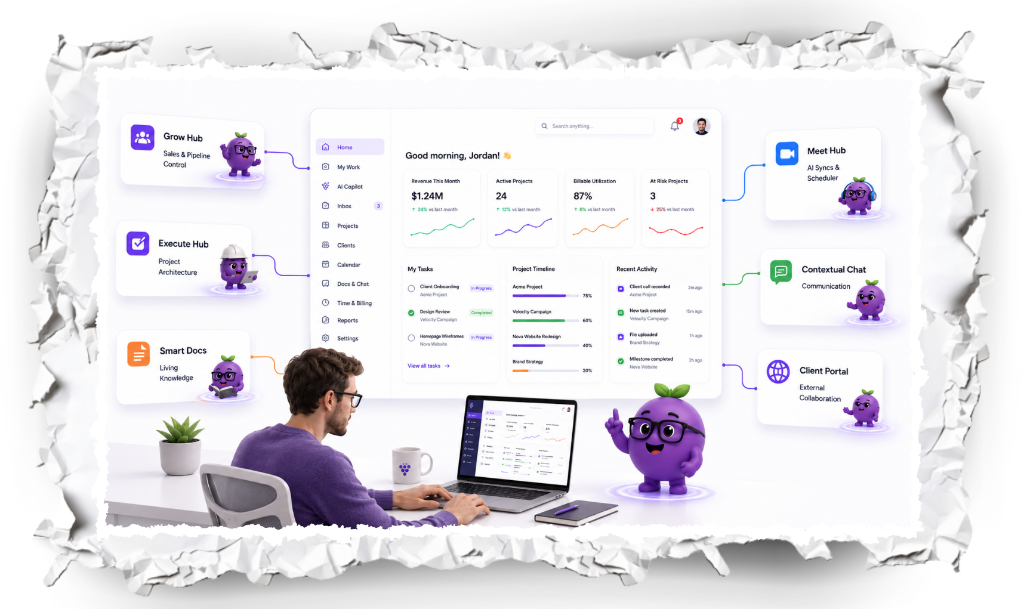
The best agency management software depends on which part of the agency you need to control. Teamwork.com and Productive are strong choices for agencies centered on time tracking, capacity, utilization, budgets, and project profitability. Scoro, Kantata, Workamajig, Accelo, and Function Point provide deeper professional-services or financial operations. ClickUp and monday.com offer flexible work management. Notion is strongest as a customizable knowledge and planning layer. Grapevine Workplace is designed for agencies that want the client lifecycle, project delivery, communication, meetings, knowledge, employee signals, and AI connected in one operating system.
This guide compares 12 platforms for agencies with approximately 10 to 50 employees. It does not name one universal winner because agencies operate differently. The right choice depends on whether your greatest constraint is project economics, resource planning, client experience, fragmented context, financial management, or flexibility.
Quick answer
- Best for connected agency operations: Grapevine Workplace
- Best for client-work project control: Teamwork.com
- Best for resource planning and profitability: Productive
- Best for financial control: Scoro
- Best for enterprise professional services: Kantata
- Best for traditional creative-agency accounting: Workamajig
- Best for flexible work management: ClickUp
- Best for customizable workflows and CRM: monday.com
- Best for retainers and service automation: Accelo
- Best for small service businesses wanting broad functionality: Agiled
- Best for creative-agency workflow and estimating: Function Point
- Best for customizable knowledge and client hubs: Notion
What is agency management software?
Agency management software is the operational system an agency uses to manage client relationships, plan and deliver work, allocate people, communicate with clients, preserve knowledge, track financial performance, and understand whether delivery is sustainable.
That definition matters because many products labeled as agency management software solve only part of the problem. A project-management platform can organize tasks without managing the commercial relationship. A professional-services automation platform can provide excellent utilization and margin data while leaving communication, meetings, knowledge, and employee feedback in separate systems. A CRM can manage the pipeline without helping the team deliver what was sold.
The real question is not which product has the longest feature list. It is which operating model your agency needs.
The agency operating system
CRM, proposals, contracts
Intake, payment, workspace
Projects, tasks, capacity
Email, chat, meetings
Knowledge, playbooks, signals
Retention, referrals, margin
How we evaluated the platforms
We evaluated each platform using criteria that matter to agencies managing multiple clients, recurring work, specialist teams, and margin pressure:
- Client lifecycle: CRM, proposals, contracts, payments, onboarding, and client history.
- Delivery: Projects, tasks, workflows, dependencies, approvals, and recurring work.
- Resource management: Workload, scheduling, capacity, skills, utilization, and forecasting.
- Financial control: Budgets, rates, time, retainers, invoices, costs, and profitability.
- Client experience: Portals, communication, approvals, files, forms, and visibility.
- Communication and meetings: Email, chat, calendars, video, transcripts, and follow-through.
- Knowledge: Documents, SOPs, playbooks, search, and reusable institutional context.
- People signals: Employee profiles, workload visibility, and employee or team feedback.
- AI context: Whether AI works across the operating system or inside isolated features.
- Implementation fit: How much configuration, process maturity, and administrative ownership the platform requires.
Product capabilities change regularly. Confirm current plans, limits, integrations, and implementation requirements directly with each provider before purchasing.
Agency management software comparison
| Platform | Best for | Primary strength | Main tradeoff | Our assessment |
|---|---|---|---|---|
| Grapevine Workplace | Agencies wanting one connected operating environment | Client lifecycle, work, communication, knowledge, people, and AI share context | Less mature than specialist PSA platforms for advanced utilization and financial modeling | Best connected agency OS |
| Teamwork.com | Client-work project control | Time, workload, retainers, budgets, client access, and profitability | Broader agency communication and knowledge may still span other tools | Best client-work PSA |
| Productive | Resource and profitability management | Scheduling, utilization, forecasting, budgeting, and financial visibility | May be more operational depth than a small agency needs | Best resource planning |
| Scoro | Financially disciplined agencies and consultancies | Quote-to-cash, budgets, capacity, billing, and financial control | Requires process maturity and thoughtful implementation | Best financial control |
| Kantata | Larger professional-services organizations | Enterprise resource management, forecasting, project financials, and business intelligence | Complexity may exceed the needs of a 10-person agency | Best enterprise PSA |
| Workamajig | Traditional creative and advertising agencies | CRM, estimating, projects, resourcing, time, billing, and accounting | A deeper operational system with a heavier adoption commitment | Best agency accounting depth |
| ClickUp | Flexible project and work management | Highly configurable tasks, views, docs, dashboards, automation, and AI | Agency economics and CRM often require configuration or additional systems | Best flexible work hub |
| monday.com | Custom workflows connecting sales and delivery | Visual workflows, configurable CRM, automation, and dashboards | The complete agency system may span multiple monday products and custom boards | Best no-code flexibility |
| Accelo | Retainer-heavy service firms | CRM, projects, retainers, time, billing, and service automation | Best value appears when the agency adopts its full service-delivery model | Best retainer automation |
| Agiled | Small service businesses needing broad functionality | CRM, contracts, projects, invoices, scheduling, HR, and client portals | Less specialist depth than dedicated PSA and resource-planning platforms | Best broad small-business suite |
| Function Point | Creative-agency workflow and estimating | CRM, estimates, project management, time, resources, and financials | More specialized around established creative-agency operations | Best creative workflow depth |
| Notion | Knowledge, planning, and lightweight client hubs | Flexible databases, documents, wikis, templates, and AI | Not a native PSA, accounting, utilization, or advanced resource-management system | Best knowledge layer |
1. Grapevine Workplace: best connected operating system for agencies
Grapevine Workplace is designed around a different premise from traditional project-management and PSA software: agencies lose operating leverage when the commercial relationship, delivery work, communication, meetings, knowledge, and employee context live in separate systems.
Grapevine connects CRM, contracts, Stripe payments, intake, workspaces, projects, tasks, client portals, chat, email, calendars, video conferencing, meetings, knowledge, playbooks, documents, forms, files, tables, employee profiles, and weekly employee and team pulse surveys. Figgy, its AI assistant, can work across that connected environment. Integrations with Stripe, Fathom, Google Calendar, Gmail, and Slack help bring outside activity into the same operating context.
Best fit: B2B service agencies with 10 to 50 employees that are tired of reconstructing client and delivery context across multiple applications.
Where Grapevine is strongest: Connecting the client journey from initial relationship through contract, payment, onboarding, delivery, communication, knowledge, and ongoing account management.
Where another platform may be stronger: Agencies that primarily need mature time capture, detailed resource forecasting, utilization targets, project accounting, or enterprise financial controls should also evaluate Teamwork, Productive, Scoro, Workamajig, or Kantata.
2. Teamwork.com: best for controlling client work
Teamwork.com is purpose-built for client-facing work. Its agency capabilities include project management, billable and non-billable time tracking, client access, workload planning, retainers, budgets, proofs, and profitability reporting.
Teamwork is a strong choice when the agency’s economic model depends on knowing how planned effort, recorded time, capacity, and budgets interact. Project managers can control delivery while leaders monitor whether client work remains profitable.
Best fit: Agencies that sell hours, manage retainers, run many concurrent client projects, or need tighter project-level financial discipline.
Main tradeoff: Teamwork provides deep delivery control, but agencies may continue using separate systems for broader CRM, contracts, email, meetings, knowledge, and employee feedback.
For a deeper analysis, read Grapevine Workplace vs. Teamwork.com.
3. Productive: best for resource planning and profitability
Productive connects sales pipeline, project delivery, resource scheduling, time tracking, budgeting, billing, forecasting, utilization, and profitability. It is one of the strongest options for agencies that want resource decisions and financial decisions to share the same data.
Best fit: Agencies with dedicated operations or finance leadership that need forward-looking capacity planning and real-time profitability visibility.
Main tradeoff: Productive’s operational depth can demand more process discipline than a small or lightly structured agency is ready to maintain.
4. Scoro: best for end-to-end financial control
Scoro combines CRM and pipeline management with quoting, projects, time, resource capacity, costs, billing, and financial reporting. Its strength is connecting what the agency expects to sell with the resources required to deliver it and the financial outcomes produced.
Best fit: Established agencies and consultancies that want strong quote-to-cash control and can commit to consistent operating data.
Main tradeoff: Scoro is not merely a task tool. Agencies need clear processes, ownership, and implementation discipline to receive its full value.
5. Kantata: best for enterprise professional services
Kantata is an enterprise-oriented professional-services automation platform. Its capabilities emphasize resource forecasting, skills, staffing, project delivery, project financials, margin, revenue, and business intelligence.
Best fit: Larger consultancies and professional-services organizations managing complex staffing, multiple practices, enterprise integrations, or sophisticated forecasting requirements.
Main tradeoff: A 10-person agency may not need the implementation effort or operational complexity associated with an enterprise PSA.
6. Workamajig: best for traditional creative-agency operations
Workamajig was built around the operating model of advertising, marketing, and creative agencies. It combines CRM, estimating, project management, resource scheduling, time tracking, billing, and full agency accounting.
Best fit: Creative agencies that want projects, traffic, estimates, time, invoicing, and accounting managed in one specialized system.
Main tradeoff: Workamajig is a substantial operational platform. Teams looking primarily for lightweight work management may find it heavier than necessary.
7. ClickUp: best for flexible work management
ClickUp gives agencies configurable spaces, lists, tasks, custom fields, multiple views, documents, dashboards, automations, time tracking, forms, chat, and AI. Its flexibility allows an agency to model many different delivery processes.
Best fit: Agencies that prioritize configurable project execution and want one flexible workspace for many teams and workflows.
Main tradeoff: Flexibility is not the same as an agency operating model. CRM, client portals, resource forecasting, project profitability, contracts, and financial processes may require configuration, integrations, or additional products.
8. monday.com: best for no-code workflow customization
monday.com combines highly visual work management with automation, dashboards, forms, and a separate CRM product. Agencies can build pipelines, client-onboarding flows, campaign boards, project plans, and leadership dashboards without traditional development.
Best fit: Agencies that want to design their own operating workflows and have someone internally who can maintain the system.
Main tradeoff: The agency may end up constructing and governing its own system across boards and products instead of adopting a purpose-built operating model.
9. Accelo: best for recurring and retainer-based services
Accelo connects CRM, quotes, projects, tasks, retainers, time, resource planning, billing, client portals, and reporting. Its automation is designed around the lifecycle of professional-service relationships rather than isolated projects.
Best fit: Agencies and consultancies managing a mix of projects and ongoing retainers that want service-delivery automation.
Main tradeoff: Accelo creates the most value when the agency adopts the platform as its service-operations backbone, not when it uses only a few modules.
10. Agiled: best broad suite for small service businesses
Agiled combines CRM, proposals, contracts, projects, invoicing, scheduling, client portals, HR functions, automations, and AI capabilities. Its breadth can help freelancers and smaller service businesses replace several separate applications.
Best fit: Small agencies and service businesses that want a broad set of business-management functions without adopting a deep enterprise PSA.
Main tradeoff: Breadth does not always equal specialist depth. Agencies with advanced resource forecasting, profitability analysis, or creative traffic requirements should compare it directly with Productive, Scoro, Teamwork, or Workamajig.
11. Function Point: best for creative workflow and estimating
Function Point is built for creative and marketing agencies. It combines CRM and estimating, project management, time tracking, resource management, financial tools, and operational reporting.
Best fit: Creative agencies that want estimates, schedules, time, resources, and financial performance connected to project delivery.
Main tradeoff: Function Point is most compelling when the agency matches its established creative-services model. Agencies seeking a broader communication, knowledge, or employee-experience layer may still require additional systems.
12. Notion: best for knowledge and customizable client hubs
Notion can serve as an agency wiki, planning system, lightweight CRM, project tracker, SOP library, and client workspace. Its connected documents and databases make it unusually flexible for organizing knowledge.
Best fit: Agencies that primarily need a customizable knowledge and planning layer or that are comfortable building their own workflows.
Main tradeoff: Notion is not a native professional-services automation or agency-accounting platform. Advanced resource scheduling, utilization, time-to-budget controls, retainers, billing, and profitability usually require templates, integrations, or other systems.
Which agency management software should you choose?
Choose by the constraint you need to remove
Start with Grapevine Workplace.
Start with Teamwork.com or Productive.
Start with Scoro, Workamajig, or Function Point.
Start with Kantata.
Start with ClickUp or monday.com.
Start with Notion.
Choose Grapevine Workplace if:
- Your agency operates across too many disconnected systems.
- Client context is repeatedly lost between sales, onboarding, delivery, meetings, and account management.
- You want communication, meetings, knowledge, work, and employee signals connected.
- You want AI to understand more than tasks inside a single project tool.
Choose a specialist PSA if:
- Your highest-priority problem is billable utilization, capacity, forecasting, or project profitability.
- You need mature project accounting or enterprise financial controls.
- Your operating model is already disciplined enough to maintain detailed time, resource, and cost data.
Choose a flexible work platform if:
- Your workflows are unusual or change frequently.
- You have internal ownership for designing and governing the system.
- You are comfortable connecting other products for CRM, finance, portals, or employee feedback.
The hidden cost most comparisons miss
Software cost is not only the subscription price. Agencies also pay for the work required to connect, update, reconcile, and explain what their systems know.
When the CRM, contract, project plan, inbox, meeting transcript, client portal, knowledge base, and employee systems are separate, someone becomes the human integration layer. Account managers rewrite updates. Project managers reconstruct decisions. Operations leaders reconcile reports. Employees search across tabs for context. Leaders discover delivery risk after it has already affected margin or client trust.
A specialized platform can be worth that coordination cost when its depth protects more margin than fragmentation consumes. A connected platform can be more valuable when fragmentation itself has become the constraint. The decision should account for both.
A practical evaluation process
- Name the operational constraint. Identify the one problem that creates the most lost margin, wasted capacity, client frustration, or leadership uncertainty.
- Map the full client lifecycle. Trace what happens from first contact through contract, onboarding, delivery, communication, renewal, and referral.
- Count the manual handoffs. Document where people copy information, rewrite updates, chase status, or reconcile competing records.
- Separate essential depth from attractive features. A sophisticated utilization model is valuable only if the agency will maintain the data it requires.
- Test a real client workflow. Do not evaluate a polished demo alone. Run one representative opportunity, contract, onboarding, project, client update, meeting, and invoice through the system.
- Include the team and the client. The best operational platform still fails if employees avoid it or clients find it confusing.
- Measure consolidation honestly. List which products can be removed, which must remain, and which integrations create new maintenance.
Final verdict
There is no single best agency management platform for every agency.
Teamwork.com is an excellent choice for agencies that need strong control over client projects, time, workload, retainers, budgets, and profitability. Productive is particularly strong for resource planning and financial visibility. Scoro, Workamajig, Function Point, and Kantata suit agencies or professional-services firms that need deeper operational and financial systems. ClickUp and monday.com provide flexibility. Notion provides an adaptable knowledge layer. Accelo serves recurring service relationships, while Agiled gives smaller firms broad all-in-one functionality.
Grapevine Workplace is the strongest fit when the agency’s main problem is not the absence of another specialized feature. It is that the client lifecycle, delivery work, communication, meetings, knowledge, and employee context do not operate as one system.
If that sounds like your agency, explore Grapevine Workplace for agencies or start a free trial.
Frequently asked questions
What is the best agency management software?
The best agency management software depends on the agency’s primary constraint. Grapevine Workplace is best for connected agency operations. Teamwork.com is strong for client-work project control. Productive excels in resource planning and profitability. Scoro provides deep financial control. Kantata serves enterprise professional services, while Workamajig and Function Point specialize in creative-agency operations.
What software do marketing agencies use?
Marketing agencies commonly use project-management platforms such as Teamwork.com, ClickUp, or monday.com; professional-services platforms such as Productive, Scoro, Accelo, or Kantata; creative-agency systems such as Workamajig or Function Point; and flexible knowledge tools such as Notion. Agencies may use Grapevine Workplace when they want CRM, contracts, client workspaces, delivery, communication, meetings, knowledge, and employee context connected.
What is the difference between project management software and agency management software?
Project-management software primarily organizes work, tasks, owners, timelines, and collaboration. Agency management software typically connects project delivery with client management, resource planning, time, budgets, retainers, billing, profitability, or client portals. An agency operating system extends further by connecting communication, meetings, knowledge, and people context with the commercial and delivery lifecycle.
Does a small agency need professional-services automation software?
A small agency may need PSA software when utilization, capacity, time, billing, retainers, or project profitability are difficult to control. If the larger problem is fragmented information and manual coordination, the agency may benefit more from a connected operating system or a simpler work-management platform.
Can one platform replace an agency’s entire software stack?
Usually not every tool. Production applications such as Adobe Creative Cloud, Figma, advertising platforms, development environments, and accounting systems may remain specialized. The realistic opportunity is to consolidate the operating layer: CRM, contracts, intake, projects, tasks, client portals, communication, meetings, knowledge, resource data, and internal coordination.
How should an agency compare software?
Start with the operational constraint creating the greatest financial or client impact. Then test each platform against a real client lifecycle, including sales, contract, onboarding, delivery, communication, meetings, reporting, and renewal. Evaluate implementation effort, employee adoption, client experience, integrations, and the number of tools the platform can genuinely replace.
Related Articles

Your Business Doesn’t Need Another Project Management Tool. It Needs a Connected Operating System.
Discover how Grapevine Workplace connects client management, contracts, projects, communication and AI to reduce operational friction and protect margins for agencies and consulting firms.

Grapevine Workplace vs. Teamwork.com: Which Is Better for Agencies?
Teamwork is stronger for resource planning and project profitability. Grapevine connects the broader client, work, communication, people, and AI system.
Ready to transform how your team works?
Join teams who've built clarity and alignment with Grapevine.
Start free trial